In January 2026, the Taliban introduced a Penal Code for Courts that provides for imprisonment and, in specified circumstances, the death penalty for alleged same-sex conduct. The de facto Ministry of Justice announced its publication in Official Gazette No. 1486 on 7 May 2026. The death penalty is not automatic for every allegation, but the Code places an explicit and grave threat in law for LGBTIQ+ Afghans.
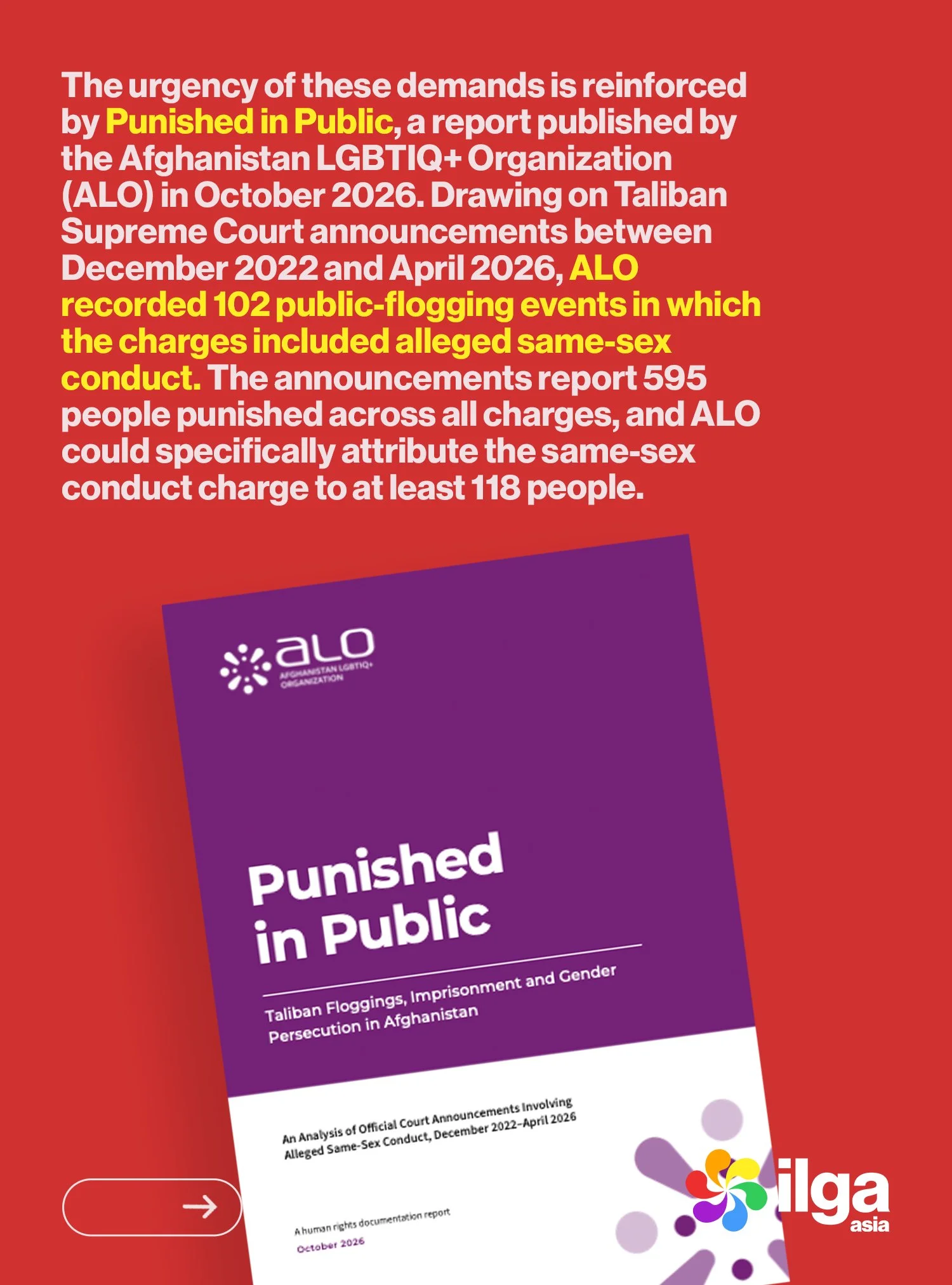
The urgency of these demands is reinforced by Punished in Public, a report published by the Afghanistan LGBTIQ+ Organization (ALO) in October 2026. Drawing on Taliban Supreme Court announcements between December 2022 and April 2026, ALO recorded 102 public-flogging events in which the charges included alleged same-sex conduct. The announcements report 595 people punished across all charges, and ALO could specifically attribute the same-sex conduct charge to at least 118 people.
These figures reflect what the Taliban chose to announce; they are not a measure of the full extent of persecution. Many announcements group several charges together without identifying persons accused of each one, so the figure of 595 is not representative of the actual number of individuals punished for same-sex conduct. ALO did not independently verify whether each punishment was carried out, whether the allegations were true, or the identities, sexual orientation or gender identity of the people reported. A Taliban charge label is not proof of conduct or identity.
A prison term was announced alongside flogging in 38 of the 102 incidents. None of the announcements before October 2024 mentioned imprisonment. Prison terms were announced in 13 of 38 incidents in 2025 (34%) and 16 of 20 incidents between January and April 2026 (80%). These figures indicate a marked increase in combined sentences of flogging and imprisonment.
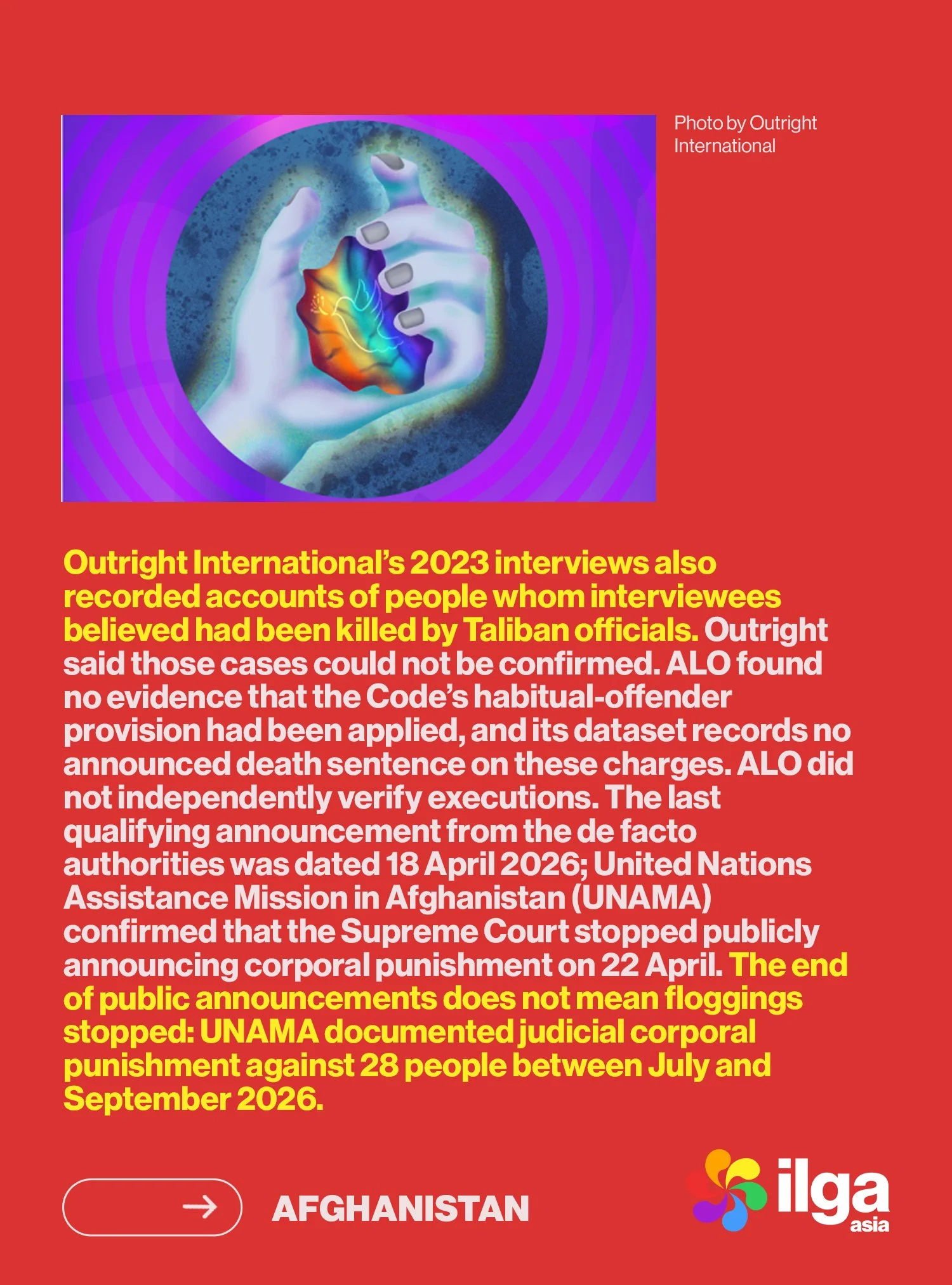
Outright International’s 2023 interviews also recorded accounts of people whom interviewees believed had been killed by Taliban officials. Outright said those cases could not be confirmed. ALO found no evidence that the Code’s habitual-offender provision had been applied, and its dataset records no announced death sentence on these charges. ALO did not independently verify executions. The last qualifying announcement from the de facto authorities was dated 18 April 2026; United Nations Assistance Mission in Afghanistan (UNAMA) confirmed that the Supreme Court stopped publicly announcing corporal punishment on 22 April. The end of public announcements does not mean floggings stopped: UNAMA documented judicial corporal punishment against 28 people between July and September 2026.
Under the Afghanistan Analysts Network’s corrected 27 April 2026 revised unofficial translation of the Penal Code, article 60 prescribes two years’ imprisonment for a proved “homosexual act” and permits death for a “habitual” offender with the religious leader’s permission. Article 14(2) separately allows the leader, “out of expediency,” to impose death for repeated homosexual acts. Article 2(11) describes people the Code calls homosexuals as “spreaders of disorder” and says the only remedy is death; article 14(1) provides for execution in the public interest with the leader’s permission. These provisions create overlapping routes to severe punishment, but do not make death automatic for every allegation. The de facto Ministry of Justice confirmed publication of the code in Official Gazette No 1486 in May 2026.
ALO notes that the Code allows discretionary punishment “even if there is doubt,” treats a person as accused on the evidence of one “just” witness or two witnesses of unknown integrity, and gives no effect to a retracted confession. ALO warns that these provisions heighten the risk of denunciation, blackmail and coerced confessions.
UN human rights experts have also warned that the provisions do not distinguish consensual from non-consensual sexual intercourse, potentially exposing victims to the same punishment as perpetrators. A charge label alone cannot establish consent, conduct or identity. Survivors must be able to seek protection and care without risking prosecution for violence committed against them.. Consensual adult intimacy must never be conflated with sexual assault or child sexual abuse. Survivors must be able to seek protection and care without risking prosecution for the violence committed against them. A Taliban charge label is not a reliable description of consent or identity.
Criminalising consensual same-sex relationships violates the rights to privacy and equality. The UN Human Rights Committee has held that criminalising consensual adult same-sex intimacy violates Covenant protections for privacy and equality. The death penalty may not be imposed for conduct whose criminalisation itself violates the Covenant, and the Covenant restricts it to the most serious crimes involving intentional killing. The Code’s rules on punishment despite doubt and limited procedural safeguards raise grave fair-trial concerns. Judicial corporal punishment is incompatible with the prohibition of torture or cruel, inhuman or degrading treatment; domestic law or public-interest claims cannot justify those violations.
“For LGBTIQ+ Afghans, the threat of death penalty is no longer just a fear. It is now explicitly written into the Taliban's criminal rules. Our documentation shows how public floggings have increasingly been combined with imprisonment, and we cannot wait for the first reported death penalty before the international community takes action.” — Artemis Akbary, Executive Director, Afghanistan LGBTIQ+ Organization (ALO) and ILGA Asia Executive Board Member
These provisions operate alongside the 2024 Law on the Propagation of Virtue and Prevention of Vice. The Special Rapporteur on Afghanistan has documented serious abuses against LGBT+ people and threats from authorities, families and communities. ALO’s dataset includes no announcement attributing a sahaq charge to a woman. Lesbian, bisexual and queer women, trans and gender-diverse people, and others whose experiences do not appear in court notices must not be overlooked. Their absence from public records is not evidence of safety.
“No one should face imprisonment or flogging for consensual same-sex intimacy. The 2026 Penal Code for Courts also provides for the death penalty in specified circumstances, deepening an already grave threat to LGBTIQ+ Afghans. States must protect people at risk, support Afghan-led organisations, and ensure that anyone seeking help can do so without further harm or danger.” — Henry Koh, Executive Director, ILGA Asia.
ILGA Asia urges states to ensure access to fair and confidential asylum procedures, legal assistance and safe pathways. UNHCR’s September 2025 guidance identifies Afghans of diverse or perceived diverse sexual orientations, gender identities and/or gender expression as likely to need international protection. Refugees and asylum-seekers awaiting a decision must not be forcibly returned. UNHCR urges caution on forced returns even for people found not to need protection, and considers it inappropriate for asylum States to send Afghan refugees and asylum seekers to Iran or Pakistan.
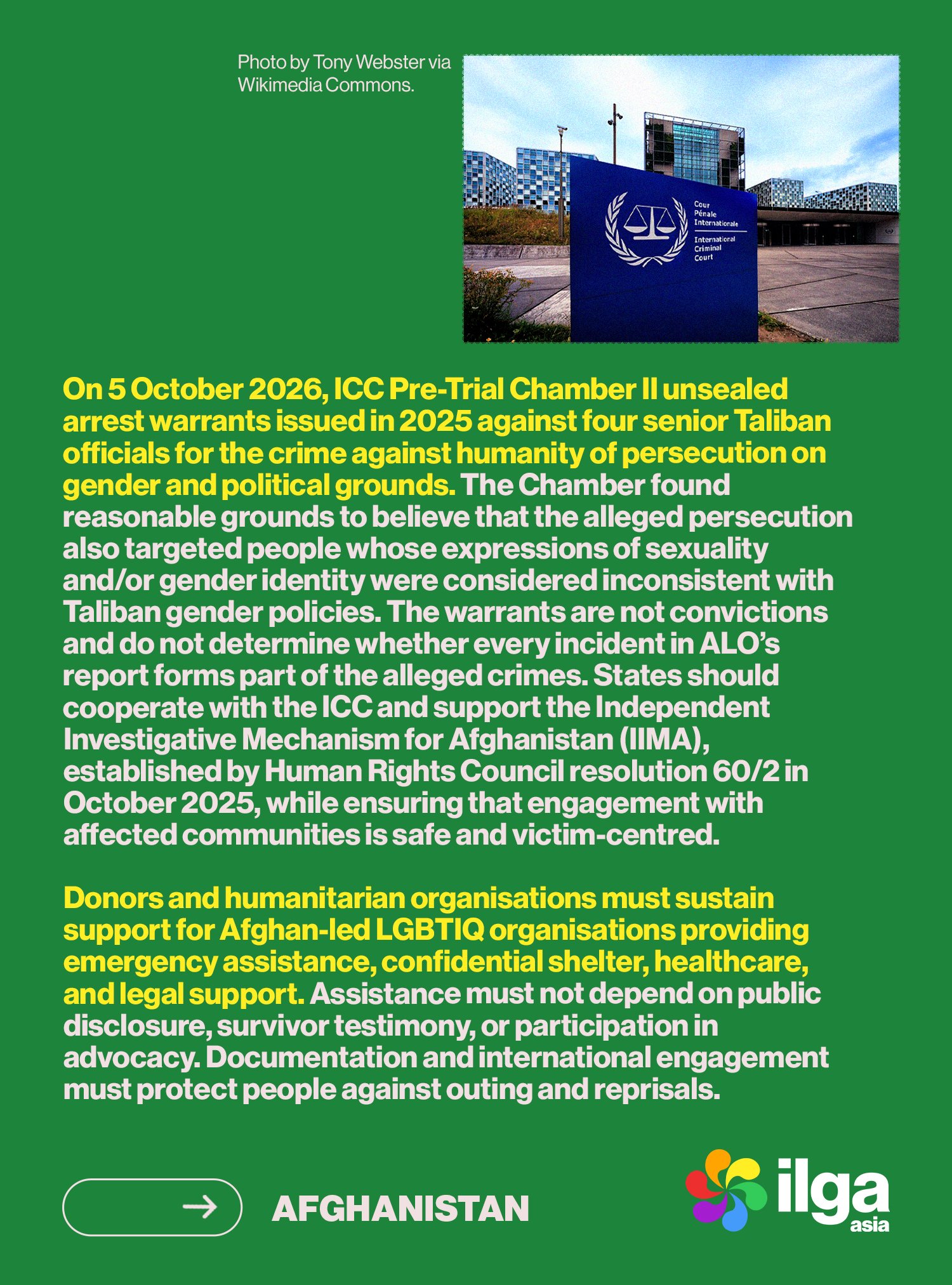
On 5 October 2026, ICC Pre-Trial Chamber II unsealed arrest warrants issued in 2025 against four senior Taliban officials for the crime against humanity of persecution on gender and political grounds. The Chamber found reasonable grounds to believe that the alleged persecution also targeted people whose expressions of sexuality and/or gender identity were considered inconsistent with Taliban gender policies. The warrants are not convictions and do not determine whether every incident in ALO’s report forms part of the alleged crimes. States should cooperate with the ICC and support the Independent Investigative Mechanism for Afghanistan (IIMA), established by Human Rights Council resolution 60/2 in October 2025, while ensuring that engagement with affected communities is safe and victim-centred.
Donors and humanitarian organisations must sustain support for Afghan-led LGBTIQ organisations providing emergency assistance, confidential shelter, healthcare, and legal support. Assistance must not depend on public disclosure, survivor testimony, or participation in advocacy. Documentation and international engagement must protect people against outing and reprisals.
ILGA Asia stands in solidarity with LGBTIQ Afghans and others targeted because of their actual or perceived sexual orientation, gender identity or expression. The Taliban de facto authorities must repeal criminal penalties for consensual same-sex conduct, end judicial corporal punishment and arbitrary detention, release people detained on discriminatory grounds, and protect survivors of violence. States and international actors should provide practical access to protection and accountability, and sustain confidential support for Afghan-led organisations.