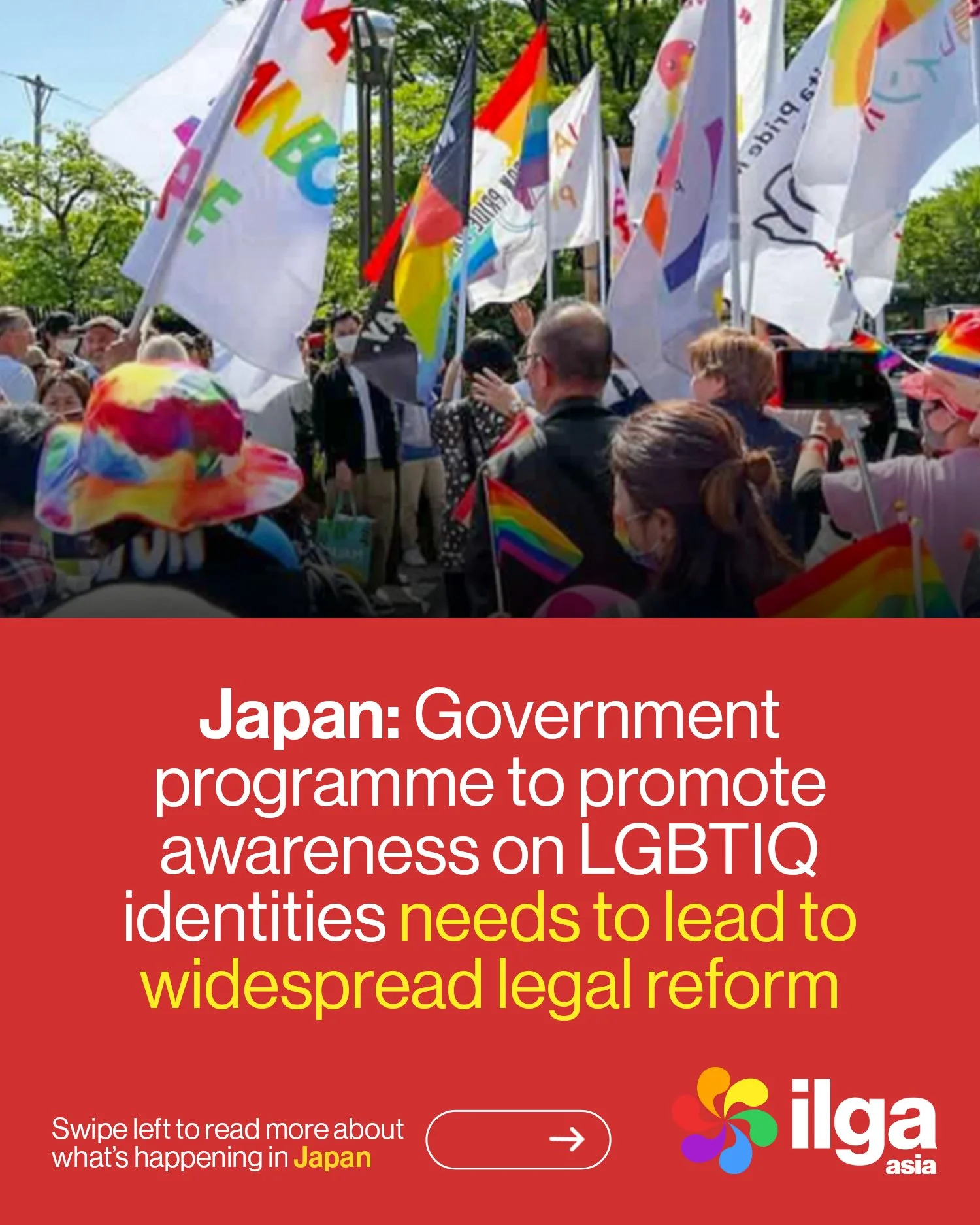
Japan: Government programme to promote awareness on LGBTIQ identities needs to lead to widespread legal reform
On 2 June 2026, the Government of Japan announced a draft programme to promote public knowledge about gender and sexual minorities. On 16 June 2026, the plan was adopted for implementation by the Cabinet. The programme will serve as a guideline under the Act on the Promotion of Public Understanding of the Diversity of Sexual Orientation and Gender Identity (SOGI Understanding Promotion Law) adopted in 2023. It aims to raise awareness in Japanese society regarding the issues faced by gender and sexual minorities, and to promote public understanding through academic research, dissemination of related knowledge, and developing community consultation systems.
National level awareness programmes like this affirm the needs of LGBTIQ communities and individuals and pave the way for broader legal and social protections. The draft programme comes following a series of progressive judicial and administrative developments on LGBTIQ issues in Japan. Many local municipalities have adopted the “partnership systems” for household registration of same-sex couples and five out of six High Courts across the nation have recognized the ban on marriage for same sex couples as unconstitutional, with only the Tokyo High Court ruling otherwise. The Osaka High Court in May 2026 ruled that the exclusion of non-binary people in Japan’s family registry was a violation of their constitutional right to equality—even though it dismissed the case—and that a gender neutral family system should be designed through a legislative process in the Diet. The Court referred to the SOGI Understanding Promotion Law with regard to lack of understanding of differences in gender identities of and protection required by transgender and nonbinary identifying individuals. The recognition of same-sex relationships and gender diverse individuals at local levels helps them access government-run services like public housing and healthcare, adding legitimacy to LGBTIQ identities and paving the way for advocacy and the realization of equal rights.
The programme aims to foster social acceptance of diverse sexual orientations and gender identities through schools, local communities, households and workplaces, and by centering the psychological impact that marginalisation has had on young LGBTIQ individuals. The government has stated that the implementation status of the plan will be shared annually and the plan will be reviewed every three years. This creates a risk of the adoption of legal measures to protect LGBTIQ individuals and communities taking a populist approach rather than one rooted in equality, dignity, and human rights. Social acceptance needs to go hand in hand with recognition of constitutionally guaranteed rights for LGBTIQ communities and individuals. The SOGI Understanding Promotion Law itself was initially imagined as an antidiscrimination bill but was subsequently negotiated to focus on awareness and promoting public understanding after political pushback from its opponents.
“Firstly, it is highly unusual that it took three years from the enactment of the Act to the formulation of the basic implementation plan, and this is deeply regrettable. On the other hand, the fact that the basic principle explicitly states that ‘the right to lead one’s social life in accordance with one’s SOGI is an important and vital legal interest intrinsically linked to one’s person’ is certainly worthy of recognition.” Akira Nishiyama, Counselor for Japan Alliance for LGBT Legislation(J-ALL) states. “However, the measures largely stick to existing provisions, and there are numerous issues, such as the fact that there is hardly any mention of the implementation of education in schools. In addition, another concern is the lack of clarity regarding the direction of these measures, as evidenced by the fact that the ‘reassurance (feeling of safety)’ of the majority people—a concept not seen in other areas—is specifically mentioned. As the minister responsible stated during the deliberations on the bill, J-ALL once again strongly urges that Evidence-Based Policy Making (EBPM) be promoted in this field as well, and that the necessary measures be implemented steadily from that perspective.”
ILGA Asia welcomes the programme adopted by the government of Japan and looks forward to progress made in social, legal, and political understandings of the issues faced by LGBTIQ communities and individuals in Japan. We further welcome the commitment towards closely consulting the community to center their voices in implementation of the plan. We strongly urge the government to adopt concrete legislative measures and administrative policies towards recognition of same-sex sexual relationships and diverse gender and sexual identities, elimination of inhumane requirements for legal gender recognition, and prioritize legal protection through anti-discrimination legislation along with promotion of public understanding for LGBTIQ communities and individuals.