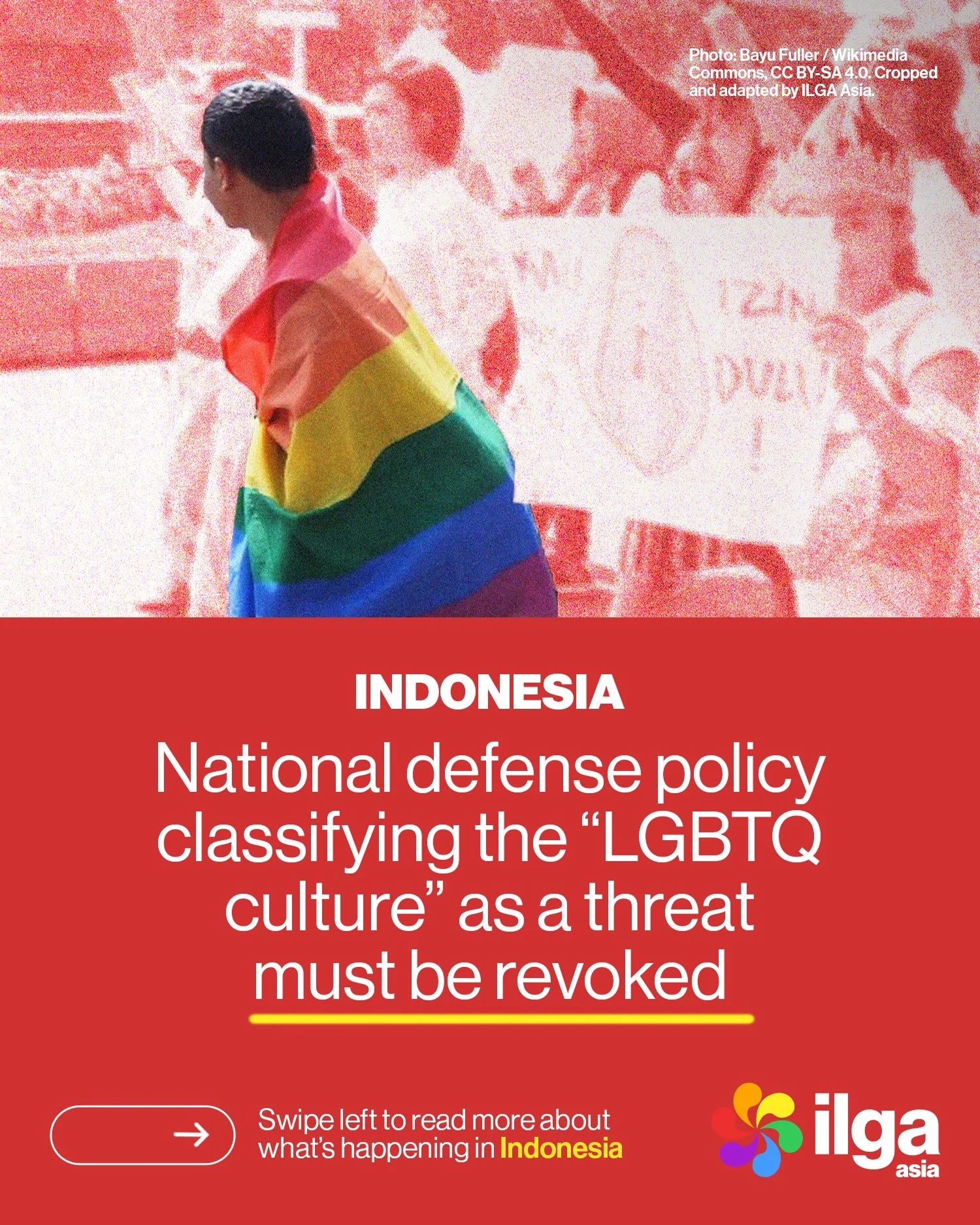
Indonesia: National defense policy classifying the “LGBTQ culture” as a threat must be revoked
The human rights situation for LGBTIQ people in Indonesia is deteriorating rapidly, amid escalating institutional discrimination, surveillance and profiling, public stigmatisation, raids, and vigilante violence. In October 2025, Indonesia adopted Presidential Regulation No. 111/2025 on the General National Defence Policy 2025-2029, which lists the “spread of LGBTQ culture” among the country’s non-military threats. By placing the ‘spread of LGBTQ culture’ within a national defense framework, the policy gives a national-security framing to sexual and gender diversity and creates political and institutional legitimacy for discriminatory policies, surveillance, restrictions, and intervention affecting LGBTIQ individuals and communities. Since July 2026, the Ministry of Religious Affairs has begun developing educational materials aimed at preventing the “spread of LGBTQ culture” through religious education, counselling and public outreach, with dedicated teams coordinating materials across religious education directorates and implementation targeted from the 2026/27 academic year.
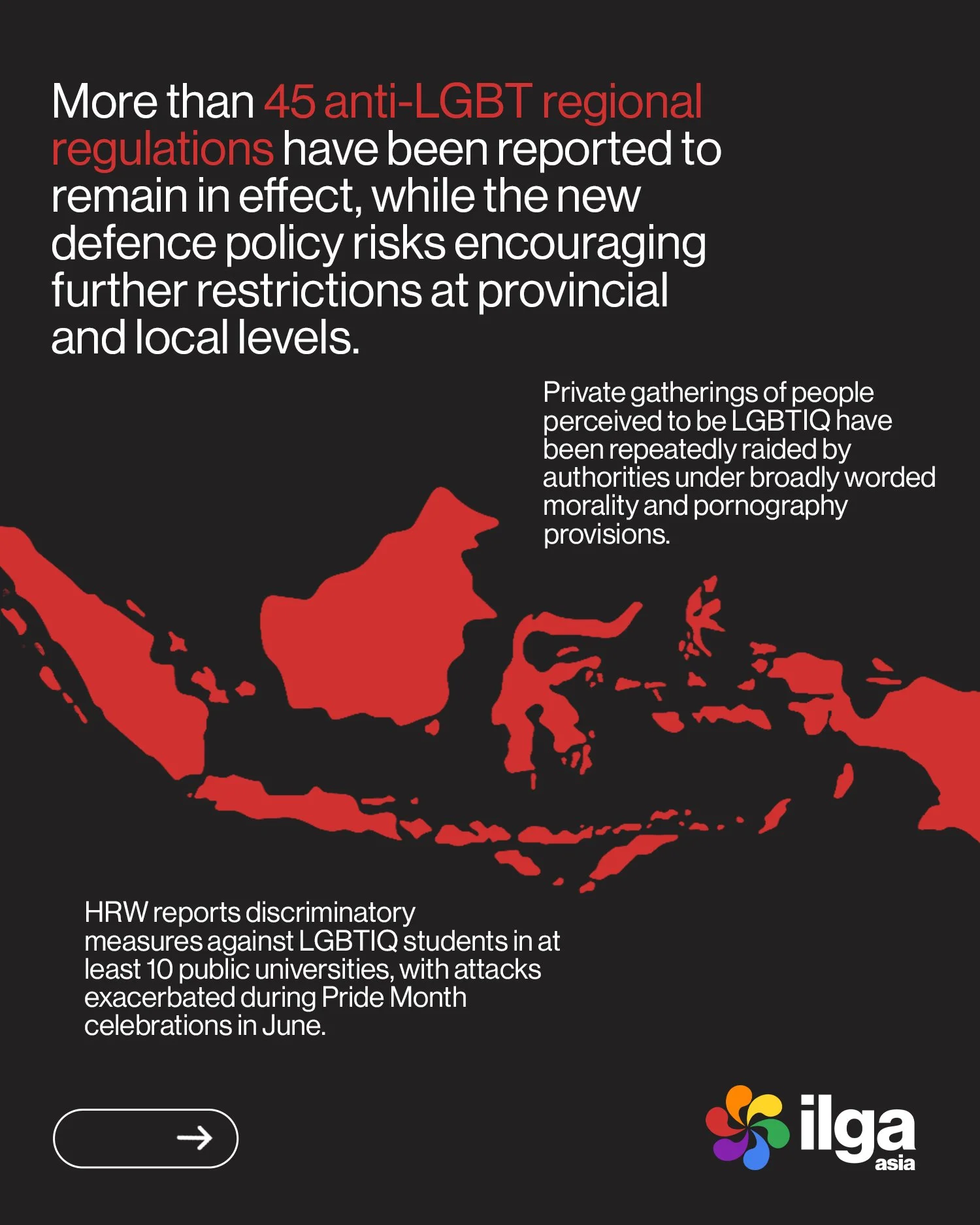
Classifying the “spread of LGBTQ culture” as a non-military threat securitises sexual and gender diversity, recasting a matter of identity, expression and human rights as one of national defence and creating political legitimacy for heightened surveillance, exclusion, and coercive intervention against LGBTQ communities. As ASEAN SOGIE Caucus has warned, “[o]nce LGBTQ are constructed as security threats rather than rights-bearing citizens, extraordinary state intervention becomes easier to justify.” Indonesia does not have a nationwide criminal offence expressly prohibiting consensual same-sex relations as such. However, LGBTIQ people continue to face risks of discriminatory criminalisation and policing through broadly worded morality, pornography and administrative provisions, while discriminatory regional laws and regulations remain in force.This national security framing builds upon an already fragmented architecture of discriminatory laws, regional regulations, administrative measures and circulars targeting LGBTIQ people. More than 45 anti-LGBT regional regulations have been reported to remain in effect, while the new defence policy risks encouraging further restrictions at provincial and local levels. Private gatherings of people perceived to be LGBTIQ have been repeatedly raided by authorities under broadly worded morality and pornography provisions. In 2025 alone, police detained 56 people following a raid on a South Jakarta hotel in February, 75 people at a privately rented villa in Bogor in June, and 34 people were arrested then paraded publicly in Surabaya in October. Authorities continue to monitor digital spaces to track down LGBTIQ communities in social media platforms; two men connected to a private Facebook group were arrested in East Java in June 2025 and the Ministry of Communication and Digital Affairs started investigation into five more groups in January 2026. In June 2026, three people were named as suspects in Karawang after a video showing alleged same-sex public indecency at a nightclub circulated widely online. Human Rights Watch reports discriminatory measures against LGBTIQ students in at least 10 public universities, with attacks exacerbated during Pride Month celebrations in June.
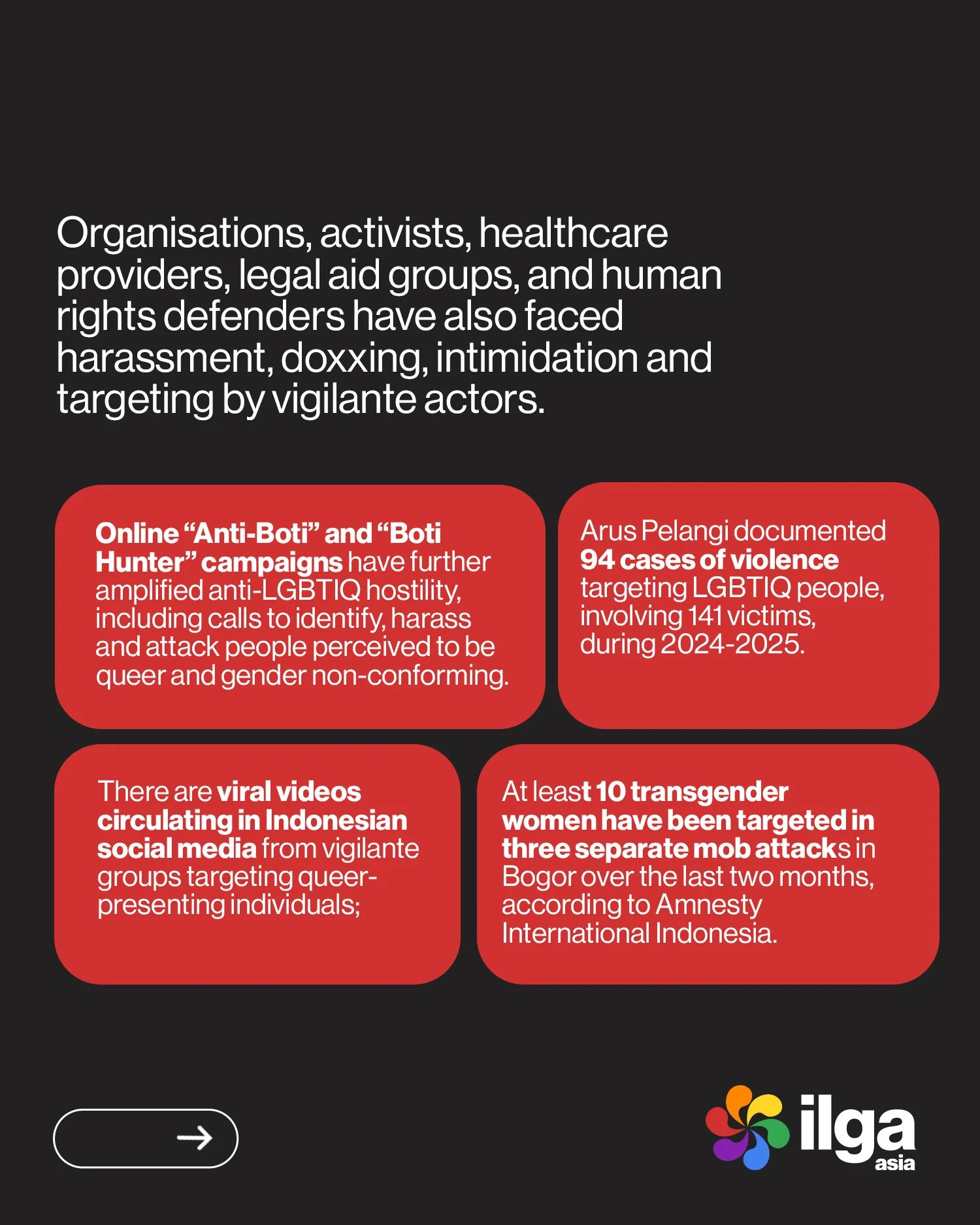
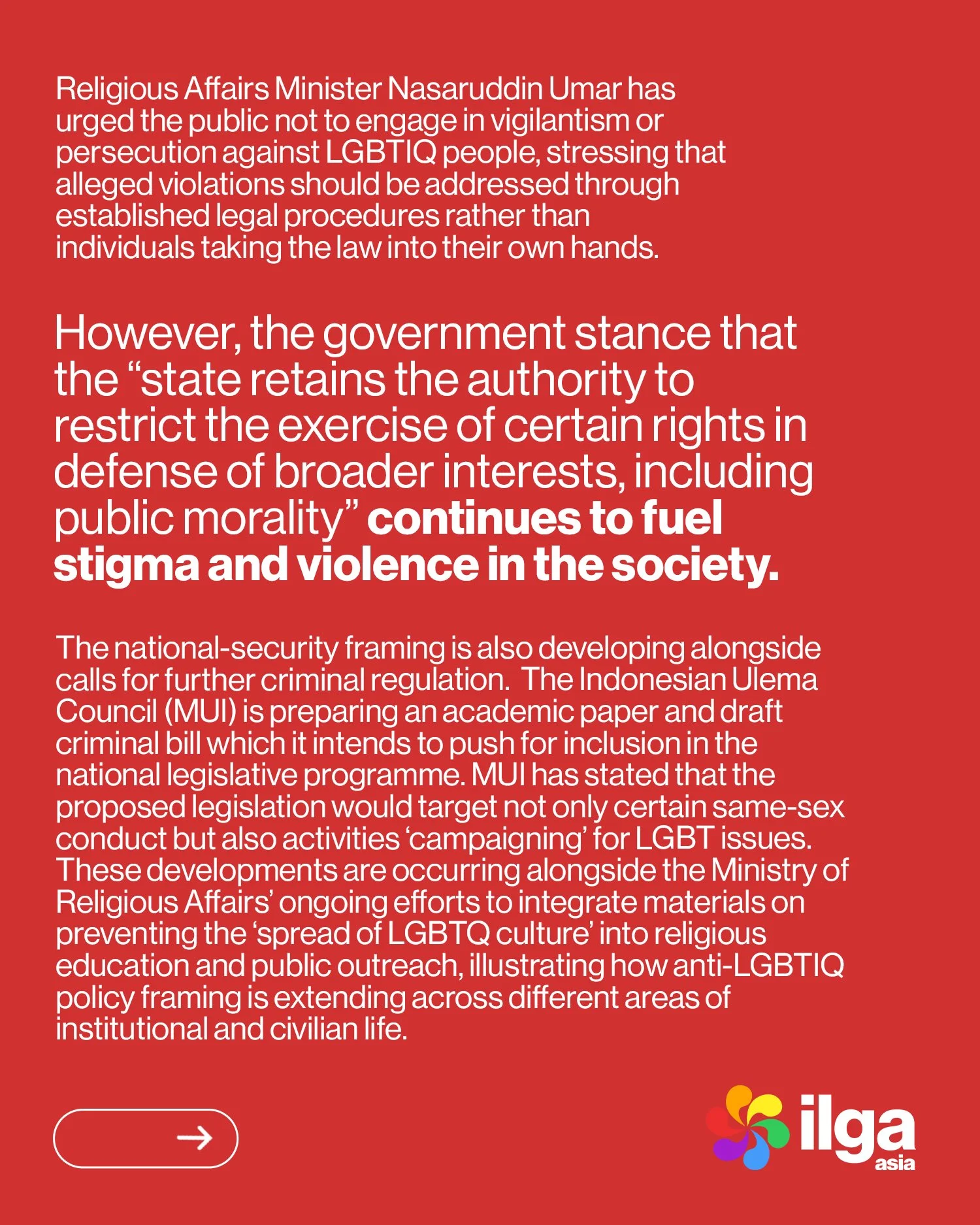
Organisations, activists, healthcare providers, legal aid groups, and human rights defenders have also faced harassment, doxxing, intimidation and targeting by vigilante actors. Online “Anti-Boti” and “Boti Hunter” campaigns have further amplified anti-LGBTIQ hostility, including calls to identify, harass and attack people perceived to be queer and gender non-conforming. Arus Pelangi documented 94 cases of violence targeting LGBTIQ people, involving 141 victims, during 2024-2025. There are viral videos circulating in Indonesian social media from vigilante groups targeting queer-presenting individuals; at least 10 transgender women have been targeted in three separate mob attacks in Bogor over the last two months, according to Amnesty International Indonesia. Religious Affairs Minister Nasaruddin Umar has urgedthe public not to engage in vigilantism or persecution against LGBTIQ people, stressing that alleged violations should be addressed through established legal procedures rather than individuals taking the law into their own hands. However, the government stance that the “state retains the authority to restrict the exercise of certain rights in defense of broader interests, including public morality” continues to fuel stigma and violence in the society.
The national-security framing is also developing alongside calls for further criminal regulation. The Indonesian Ulema Council (MUI) is preparing an academic paper and draft criminal bill which it intends to push for inclusion in the national legislative programme. MUI has stated that the proposed legislation would target not only certain same-sex conduct but also activities ‘campaigning’ for LGBT issues. These developments are occurring alongside the Ministry of Religious Affairs’ ongoing efforts to integrate materials on preventing the ‘spread of LGBTQ culture’ into religious education and public outreach, illustrating how anti-LGBTIQ policy framing is extending across different areas of institutional and civilian life.
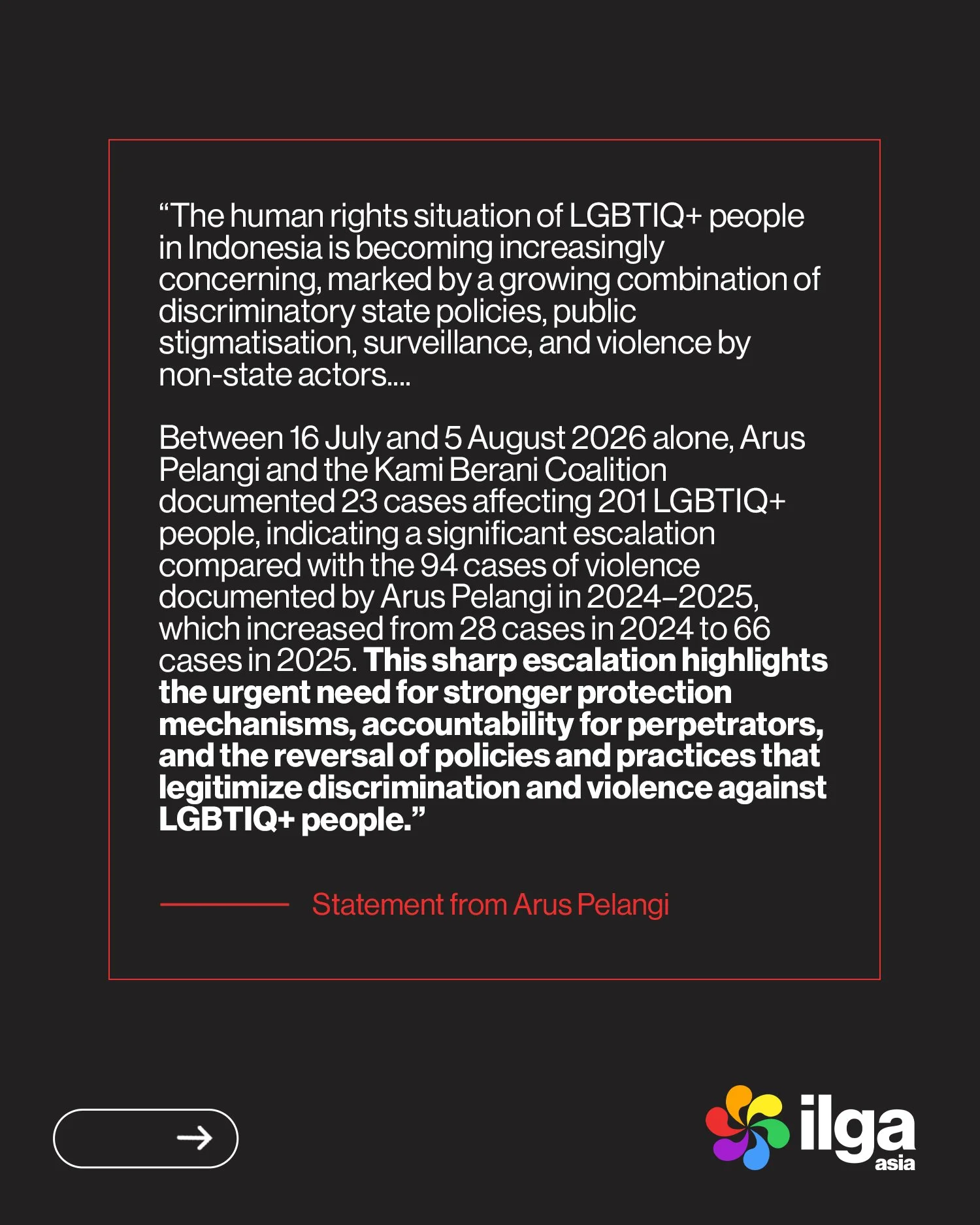
“The human rights situation of LGBTIQ+ people in Indonesia is becoming increasingly concerning, marked by a growing combination of discriminatory state policies, public stigmatisation, surveillance, and violence by non-state actors. The designation of the “spread of LGBT culture” as a national security threat under Presidential Regulation No. 111/2025 has contributed to the institutionalisation of discriminatory narratives and created greater space for LGBTIQ+ identities and communities to be subjected to surveillance, monitoring, and control. These developments are further reinforced by initiatives to introduce anti-LGBTIQ+ narratives into the educational curriculum of institutions under the Ministry of Religious Affairs, alongside proposals for national and local regulations that criminalise LGBTIQ+ people and promote approaches that pathologise sexual orientation and gender identity. At the same time, raids, online hate speech, doxxing, and vigilante attacks are becoming increasingly prevalent. Between 16 July and 5 August 2026 alone, Arus Pelangi and the Kami Berani Coalition documented 23 cases affecting 201 LGBTIQ+ people, indicating a significant escalation compared with the 94 cases of violence documented by Arus Pelangi in 2024–2025, which increased from 28 cases in 2024 to 66 cases in 2025. This sharp escalation highlights the urgent need for stronger protection mechanisms, accountability for perpetrators, and the reversal of policies and practices that legitimize discrimination and violence against LGBTIQ+ people.” —Statement from Arus Pelangi.
“When a state places the ‘spread of LGBTQ culture’ within its national defence doctrine, it crosses a dangerous line. It takes prejudice that may already exist in society and gives it the vocabulary and authority of national security. The distinction between targeting ‘culture’ and targeting people becomes impossible to sustain in practice when it is people — their relationships, expression, communities and organising — who ultimately become the objects of scrutiny and intervention.What concerns us most is how this logic can travel beyond a single policy document and become embedded across institutions and everyday governance. National cohesion cannot be protected by constructing a minority of citizens as something the nation must be defended against. A strong state does not demonstrate its strength by policing difference, but by protecting equal citizenship, human dignity and the rule of law — especially when doing so is politically difficult.” — Henry Koh, Executive Director, ILGA Asia.
ILGA Asia calls on the Government of Indonesia to remove the classification of the “spread of LGBTQ culture” as a non-military threat from Presidential Regulation No. 111/2025 and ensure that national defence, education, public-order and other state policies do not discriminate against people on the basis of their sexual orientation, gender identity or expression, or sex characteristics.
The Government should halt measures that stigmatise LGBTIQ people or portray their identities, relationships, expression and organising as threats to society; review national and regional laws and regulations that facilitate discrimination against LGBTIQ people; and ensure prompt, effective and impartial investigations into vigilante attacks, harassment and other violence against LGBTIQ communities and human rights defenders. The Government and the House of Representatives should also reject proposals to criminalise consensual same-sex intimacy or advocacy for LGBTIQ human rights.All restrictions pursued in the name of national security, public morality or religion must remain consistent with Indonesia’s constitutional guarantees and its international human rights obligations, including the principles of legality, necessity, proportionality and non-discrimination.